By Eric Engelbert
A long quiet stretch of office buildings on Mill Creek Drive in Laguna Hills is about to become one of the largest residential redevelopments the city has seen in decades. The project, called Terravita, will replace two former office campuses with 480 new homes. The Laguna Hills City Council approved it in February 2026 on a 4 to 1 vote, though the developer did not formally announce it until June.
Mill Creek Drive itself is easy to miss. It is not a heavily traveled corridor, and most drivers passing through Laguna Hills on Moulton Parkway or El Toro Road would never notice the two office campuses tucked along it. East of Moulton Parkway, the area is lined with additional offices and light industrial buildings rather than rooftops, which is exactly the kind of low profile, already built out commercial setting that makes a project like this easier to slot in without disrupting an established residential neighborhood directly. It is, in a lot of ways, a quietly well chosen site for 480 new homes.
If you own a home nearby, or you are watching this market as a buyer or investor, here is what is actually happening, what residents are concerned about, and what it could mean for values in the surrounding subdivisions.
What Is Being Built, and Where
The project sits on 18.5 acres at the northeast corner of Mill Creek Drive and Ridge Route Drive, combining two former office properties. According to the City of Laguna Hills' own planning records, the full site spans 23272, 23282, 23422, 23382, and 23332 Mill Creek Drive, plus 24461 and 24411 Ridge Route Drive, covering the HERE at Laguna Hills campus and Spectrum Summit Plaza. For more than 40 years this land was strictly commercial office space. Spectrum Summit Plaza was reported to be about 95% leased with roughly 40 smaller tenants before the sale, though no high profile anchor tenant names turned up in the public record. Cigna sold the HERE campus to the development team for $64 million in 2022, and the Summit Plaza parcels sold separately for $14.5 million in 2023.
The developer is a partnership between Las Vegas based Kingsbarn Realty Capital and Development and Irvine based Kelemen Company. The plan calls for demolishing seven existing office buildings and replacing them with:
- 259 attached homes for sale, a mix of three story duets, duplexes, and triplexes
- 221 apartment units in a single, six story building, including 24 reserved for very low income households
- A six level, 380 stall parking structure
- Private parks and recreation space woven through the site
This 259 and 221 breakdown, 480 units total, is confirmed in the developer's own Letter of Justification filed with the City of Laguna Hills on February 18, 2026, and again in the project's Fiscal Impact Analysis. A few secondary commercial real estate listing sites describe an earlier version of the project at 254 single-family units and 210 apartment units in a five story building. That figure does not appear in any city planning record, so it looks like outdated marketing data rather than a competing official source. The 480 unit total is the one to go by.
The surrounding stretch along Moulton Parkway remains largely commercial and light industrial, which limits the number of existing residential neighbors sitting directly inside the construction zone.
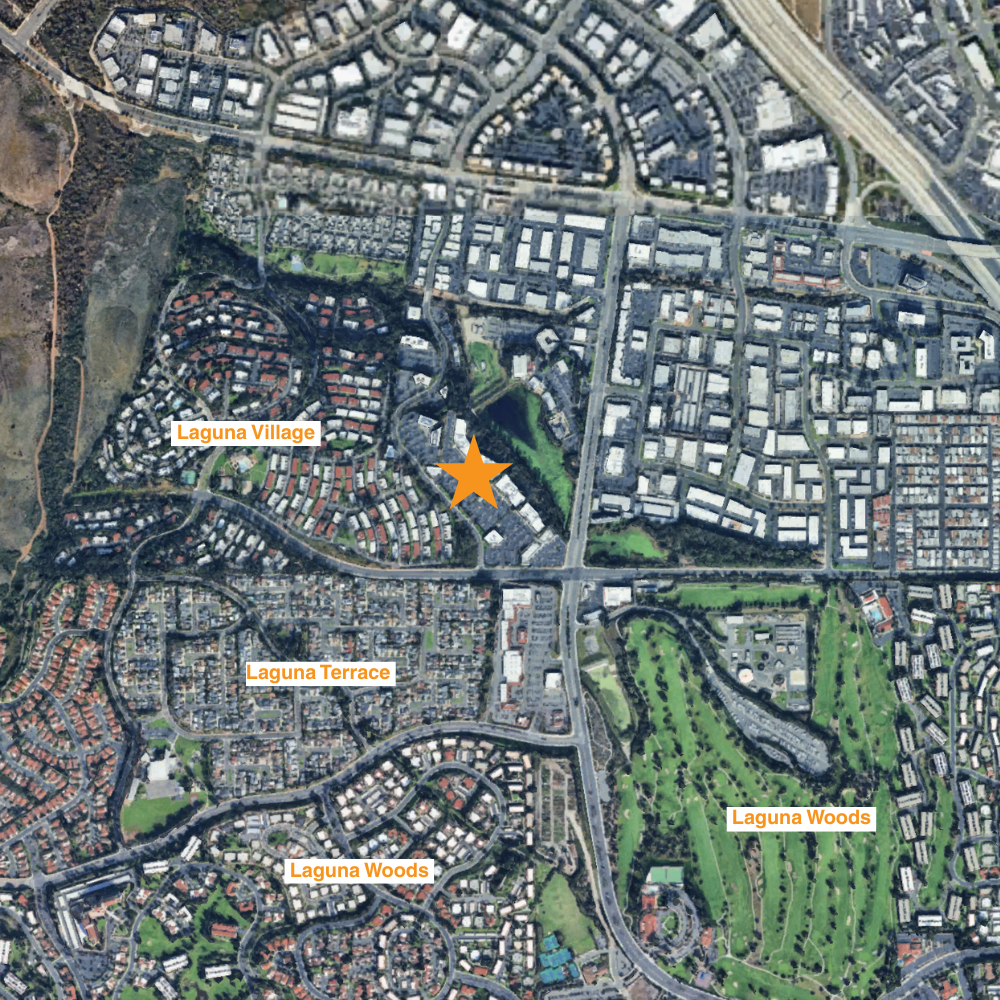
The closest single family home subdivision is Laguna Terrace, adjacent to the south side of Ridge Route Drive. It is a neighborhood of mostly single level homes, currently selling between $1,000,000 and $1,250,000, and it sits closer to the project site than any other detached home community in the area.
The Business Journal estimates total project cost above $300 million, or roughly $650,000 per unit before the parking structure. A construction start date has not yet been publicly announced, which matters for anyone trying to time a purchase around this project, more on that below.
Why the Council Approved It Despite Mixed Feelings
This project did not sail through on enthusiasm. The council vote was 4 to 1, and even some of the yes votes came with reservations. Councilman Dave Wheeler voted no and described the state's housing mandate as "an endless morass." Councilwoman Erica Pezold voted yes but said publicly that she would have preferred single family homes with accessory dwelling units instead, and that "this project isn't the best project. It's not."
The driver behind all of it is the state's Regional Housing Needs Assessment, which requires Laguna Hills to plan for 1,985 new housing units, with 46% reserved for low and very low income households. Cities that do not zone for their required density risk fines and the loss of state funding. The city identified this office campus, underused in a softening office market, as one of its easiest paths to hitting that number without touching established single family neighborhoods directly.
What the Community Is Worried About
Local reaction has been mixed at best. The concerns showing up most consistently from nearby residents center on traffic along Mill Creek Drive and Ridge Route Drive, construction disruption over what could be a multi year build, and the strain an additional 480 households could put on local schools, which are part of the Saddleback Valley Unified district.
The property directly across Mill Creek Drive is Laguna Village, a condominium community built in 1976. Of all the surrounding residential properties, Laguna Village sits closest to the construction zone, and residents there are the ones most likely to feel the day to day impact of grading, hauling, and vertical construction once the project breaks ground. Veeh Reservoir sits just behind the site and supplies water to the surrounding community. Nothing in the public record indicates that reservoir maintenance or improvements are part of Terravita's scope, which means protecting water quality during a multi year construction project, grading, runoff, erosion control, falls under standard environmental compliance rather than a dedicated reservoir upgrade. It is worth watching the city's water quality monitoring reports once grading begins, simply to confirm the reservoir is being protected throughout construction.
On the school question, the data is more nuanced than a simple downgrade. Laguna Hills High School actually carries a solid reputation, an A grade from Niche and a top 350 statewide ranking from US News, with a 96% graduation rate and an International Baccalaureate program, a rare offering even among strong schools. But proficiency rates on state math testing run lower, around 31%, which is the kind of number that shows up in school rating sites and can weigh on buyer perception even when the school's overall profile is strong. That gap between reputation and raw test score data is likely part of why Laguna Hills home values have not fully caught up to comparable coastal and inland Orange County cities, and it is worth watching whether 480 new households shift those numbers in either direction once school age children move in.
None of these concerns are unique to Terravita. Every infill housing project built under the state's RHNA mandate generates some version of this same conversation. What makes this one notable is the scale, 480 units is a meaningful addition to a city of Laguna Hills' size, concentrated on a single site.
What These Units Might Cost, and the Likely Bedroom Mix
Kingsbarn and Kelemen have not released floor plans or a public price list for Terravita, but there is now an actual sourced number to work from. The project's Fiscal Impact Analysis, prepared by Kosmont Companies for Kingsbarn Realty Capital and filed with the City of Laguna Hills, updated in February 2026, states the project's own planning assumption: an average sale price of $1,680,000 per for-sale unit. That is not a market comparison, it is the developer's own financial filing with a government agency, which makes it considerably more reliable than estimating off nearby comps.
No bedroom by bedroom breakdown has been released, but this average reframes the picture. The 259 for-sale homes are a mix of 46 duets, 107 duplexes and triplexes, and 106 duplexes, three story attached product likely spanning 2 to 4 bedroom layouts. If the average across that whole mix is $1.68 million, the smaller 2 bedroom units almost certainly sit below that average, while the larger 4 bedroom triplex units are more likely priced above it, not at or below $1,000,000. The 221 unit apartment building, including the 24 affordable units, is the more likely home for a studio to 2 bedroom rental mix and is valued separately from the for-sale average.
For context, the closest active new construction comparable, Rancho Mission Viejo, has 3 to 4 bedroom townhomes from Shea Homes and Lennar starting in the low $1 millions for fall 2026 delivery, and area medians run from about $912,500 in Aliso Viejo to roughly $1,069,000 in Laguna Hills. Terravita's official average sale price assumption is meaningfully higher than those numbers, which suggests the project, or at least its largest units, is being underwritten as a premium product for this submarket rather than a discount one. A $1,000,000 four bedroom home here looks less likely than one priced well above $1.68 million, based on the developer's own numbers.
Quick Math on the Project's Costs and Potential Revenue
The Business Journal's reporting puts total project cost above $300 million, or roughly $650,000 per unit blended across all 480 units, before the parking structure. That is a construction cost figure, not a sale price. The project's own Fiscal Impact Analysis gives a real number for the revenue side, an assumed average sale price of $1,680,000 per for-sale unit.
Multiply that across the 259 for-sale homes and the for-sale component alone pencils out to roughly $434.9 million in gross sales revenue, well above the $300 million total project cost figure reported elsewhere. The same analysis estimates the completed project's total assessed value at approximately $480 million once the apartment building is factored in. By comparison, the existing office buildings on the site are assessed at about $79.5 million today and last traded for roughly $75.5 million combined, which gives a sense of just how much value redevelopment is expected to create.
The 221 unit apartment building works differently, it produces income through rent rather than a one time sale, and the Fiscal Impact Analysis assigns it an assessed value of roughly $356,200 per market rate unit rather than a sale price.
None of this accounts for land basis, financing costs, or the affordable housing requirements baked into the approval, all of which affect the developer's actual return. But the gap between an estimated $300 million build cost and an estimated $480 million completed value, with for-sale revenue alone projected near $435 million, is the kind of spread that explains why a developer takes on a project this size despite the entitlement headaches.
What This Could Mean for Nearby Home Values
Projects like this typically affect nearby values in two phases.
During construction, it is reasonable to expect some softness in the immediately adjacent subdivisions. Laguna Village, directly across Mill Creek Drive, is the property most likely to feel this first and most directly, simply due to proximity. Construction noise, dust, truck traffic, and a constantly changing streetscape are not appealing to buyers, and sellers near active job sites often need to price more competitively or wait longer for an offer. This is a well documented pattern, not specific to Terravita, large scale residential and commercial buildouts routinely create a temporary drag on resale activity in the immediate radius while dirt is moving.
After completion, the picture tends to flip. New rooftops bring new rooftops worth of demand for nearby restaurants, retail, and services, which is generally a net positive for surrounding property values once the dust settles. 480 new households, a mix of first time buyers, renters, and downsizers based on how the developer has described the target market, also means 480 new comparable sales and rental data points feeding into future valuations in the immediate area, which can support pricing for nearby resale homes rather than dilute it, especially if Terravita's for sale units price at a premium per square foot relative to older surrounding stock.
This pattern, values dipping short term before recovering and growing long term, lines up with how these cycles have generally played out elsewhere in Orange County. The bigger variable here is timeline. Since the developer has not announced a construction start date, the "discount window" for buyers willing to tolerate construction has not opened yet, and it is impossible to say today exactly how long it will last once it does. Projects of this size, demolition, infrastructure, vertical construction, and lease up or sellout, typically run three to five years start to finish.
For anyone who wants to track this rather than take it on faith, the Laguna Hills real estate market report updates every 5 minutes with average list price, average close price, and days on market pulled directly from the MLS. Watching those numbers over the next few years is the most reliable way to see whether this construction dip and recovery pattern actually shows up in Laguna Hills the way it has elsewhere.
Could an Investor Time This Market?
Possibly, and there is more than one way to approach it. A few strategies worth understanding, none of which should be treated as financial advice without running your own numbers and talking to your accountant or financial advisor:
- Buy during the construction dip. If a homeowner near the site needs to sell during active construction and prices accordingly, that can be an entry point for a buy and hold investor who is comfortable riding out a year or two of disruption in exchange for a lower basis.
- Buy and hold for the long term reposition. This is the lower risk, lower effort version, purchase nearby now, hold through construction, and let the neighborhood's amenity base and comparable sales catch up once Terravita delivers.
- Watch the for sale product itself. The 259 duets, duplexes, and triplexes will be new construction in a market where most surrounding inventory is decades old. Early phase pricing on new construction sometimes comes in below where later phases sell, once the developer has sales momentum and fewer incentives to offer.
- Rental positioning near the apartment component. A 221 unit apartment building will bring renters who need everyday services nearby. Investors holding smaller multifamily or single family rentals within a short distance may see steadier rental demand once that population lands.
- Watch the school data over time. If Laguna Hills home values have genuinely been suppressed by school perception rather than reality, any shift in those numbers, in either direction, as new families move in could be an early signal worth tracking before the broader market reprices around it.
- Benchmark against where new construction is already concentrated. Right now the heaviest concentration of new build product in Orange County is in Rancho Mission Viejo, followed by Irvine, with its Great Park and Portola Springs neighborhoods, Tustin, where Tustin Legacy continues to build out, and Lake Forest. Comparing what builders are charging for similar floor plans in those cities is the most reliable way to sanity check Terravita's pricing once it is actually released.
The honest caveat: none of this works without a real construction timeline, which has not been released yet. I am tracking the city's project page and will update this post the moment a schedule is announced.
Thinking About Buying, Selling, or Investing Near This Project?
Whether you own a home near Mill Creek Drive and want to understand how this affects your timing, or you are an investor looking at the surrounding neighborhoods with this project in mind, I am happy to run the actual numbers for your specific situation and street.