Posted August 2026 | By Eric Engelbert
Newport Beach Overrode Its Own Airport Commission to Build 67 Condominiums on Quail Street. Here Is Why.
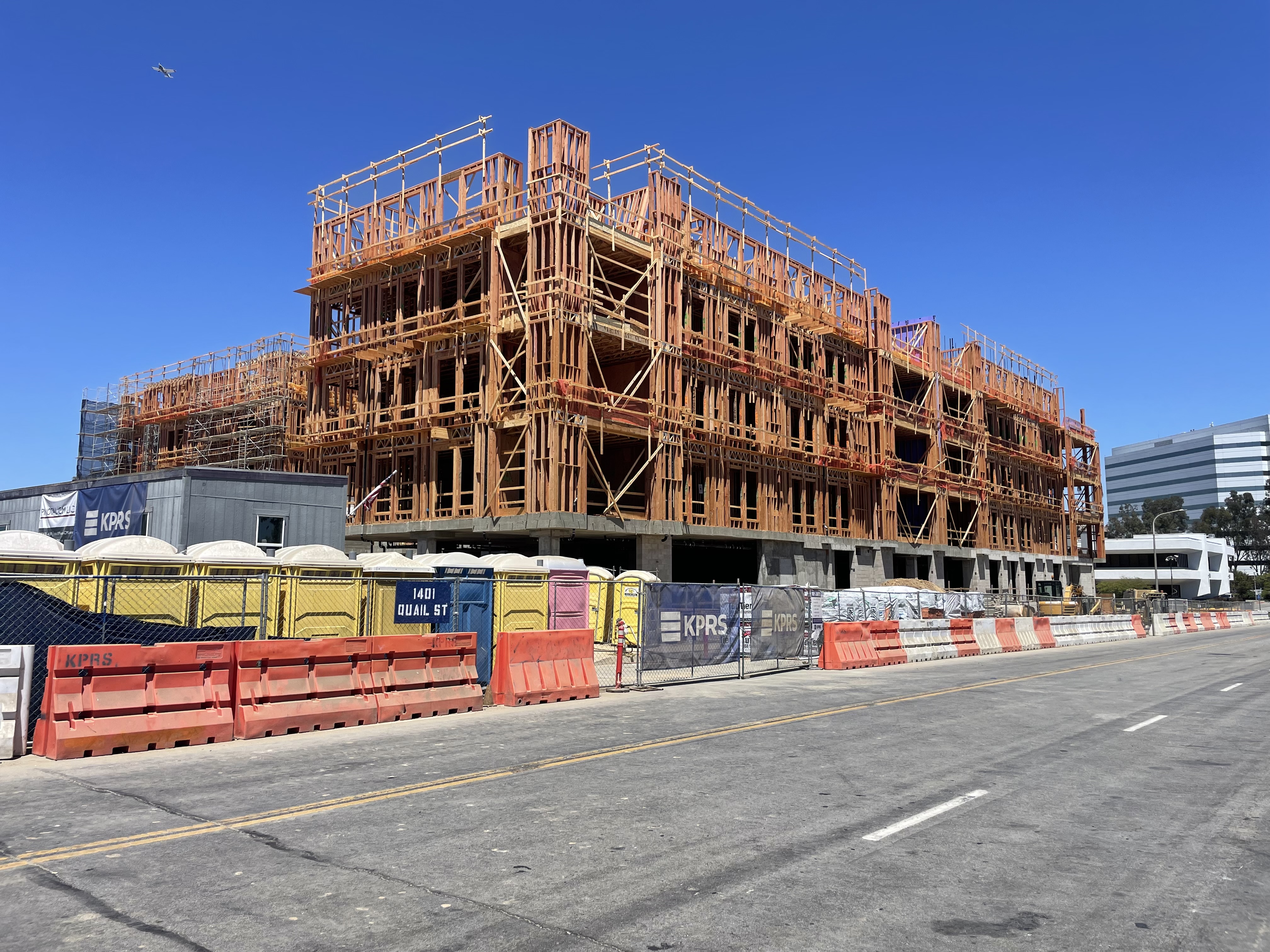
A six-story condominium building is rising at 1401 Quail Street in Newport Beach, one block from the runway approach to John Wayne Airport. Intracorp Homes, a Vancouver-based developer with a Newport Beach office, is delivering 67 for-sale condominiums above a 146-space parking structure. The general contractor is KPRS Construction Services. The building topped out its podium in 2025 and is now framing residential floors above it.
Getting here required Newport Beach's City Council to override its own airport commission, which had formally declared the project incompatible with the airport's land use plan. The council voted to override anyway. The reason matters: Newport Beach is running a deliberate strategy of concentrating the housing it is required to build near John Wayne Airport rather than dispersing it into the city's established residential neighborhoods. That strategy has implications for anyone watching Newport Beach real estate, and it will not end when this building delivers.
The Building: 67 For-Sale Condominiums on a Podium Above a Parking Structure
| Address | 1401 Quail Street, Newport Beach, CA 92660 |
|---|---|
| Developer | Intracorp Homes |
| General Contractor | KPRS Construction Services |
| Building Height | Six stories, 81 feet |
| Total Units | 67 for-sale condominiums |
| Market-Rate Units | 59 |
| Affordable Units | 8 |
| Parking | 146-space parking structure |
| Gross Square Footage | 139,546 SF |
| Density | 39 units per acre |
| Density Bonus Used | 27.5% increase (California State Density Bonus Law) |
| Planning Commission Vote | 6-0, December 21, 2023 |
| City Council Vote | Approved April 9, 2024 (with ALUC override) |
| Status | Under construction; broke ground 2025 |
The site previously held a single-story commercial office building of approximately 22,900 square feet, which was demolished to make way for the project. The building uses a concrete podium for the parking structure with wood-frame residential construction above it, a format common in California for mid-rise projects of this scale. Intracorp is marketing the homes as a luxury mid-rise product positioned for the Newport Beach Airport Area market.
Newport Beach Is Deliberately Concentrating New Housing Near the Airport
To understand why this building exists at this location, you need to understand how Newport Beach is responding to California's housing mandate. The state assigned Newport Beach 4,845 new housing units to plan for during the 6th Housing Element Cycle, which runs from 2021 through 2029. Newport Beach has to identify where those units go, get the zoning in place, and demonstrate a realistic path to production.
Newport Beach is a city of established, expensive residential neighborhoods. Balboa Island, Corona del Mar, Newport Coast, East Bluff, the Peninsula -- these are areas where homeowners, neighborhood associations, and city council members have strong incentives to resist new density. The airport area offers an alternative that is politically and practically easier: it is dominated by aging office and industrial buildings, it already has commercial traffic and noise, and a 2006 General Plan decision set aside capacity for up to 2,200 residential units specifically in that zone.
Newport Beach has leaned into that. The city is targeting roughly 2,577 of its 4,845 RHNA units in the airport area -- more than half of its entire state obligation concentrated in one corridor. To attract developers to the zone, the city also cut its affordable unit requirement for airport area projects from 30 percent down to 15 percent. At 1401 Quail, Intracorp committed 8 of 67 units as affordable (about 12 percent), using a density bonus affordability structure that exchanged a lower on-site affordable percentage for development waivers including building height and setback relief.
The logic for existing Newport Beach homeowners is straightforward: if the state is going to force the city to allow more housing somewhere, better to concentrate it near the airport than to scatter it through Balboa Crest or Newport Heights. Whether that logic holds as the airport area builds out -- and what it means for property values along Quail and Bristol -- is the question residents in adjacent neighborhoods are watching.
The Airport Commission Said No. The City Council Said Yes Anyway.
On January 18, 2024, the Orange County Airport Land Use Commission (ALUC) formally determined that the 1401 Quail Street project was inconsistent with the 2008 John Wayne Airport Environs Land Use Plan. The ALUC's objections were straightforward: the airport zone exists to protect airport operations and to keep people out of areas with significant aircraft noise. Putting 67 residential units one block from an active runway approach, the commission argued, works against both goals.
This is not a paperwork objection. The aircraft noise in the airport area is real and constant. The building at 1401 Quail is directly under the approach path, which is visible in the construction photo -- the plane in the upper left of that image is no coincidence. Residents in the building will experience regular jet noise from JWA commercial flights, and state law requires noise disclosures to homebuyers in airport influence areas.
Despite the ALUC's determination, Newport Beach's City Council voted to override it on April 9, 2024 -- the same meeting at which the council approved a companion project from Picerne Group at 1400 Bristol Street, directly across the street. Overriding an ALUC requires the local jurisdiction to adopt specific findings, and Newport Beach's findings essentially argued that the city's housing obligation under state law overrides the land use compatibility concerns raised by the commission.
Newport Beach's assistant city manager summarized the city's position directly: "If a developer has affordable housing in its project, cities have little chance in voting that down. It's in the city's best interest to approve where the housing will go. If we don't, we lose local control." The council accepted that framing. The override passed and the Notice of Determination was posted the following day.
The adjacent Picerne project at 1400 Bristol is worth noting separately. Picerne had already received approval for a 312-unit apartment complex on that site. The new approval adds 229 more apartments, with a pedestrian bridge connecting both complexes. That means the corner of Quail and Bristol is adding nearly 400 residential units within a short walk of each other, all in the airport noise zone, all approved over ALUC objections.
What Is on the Ground Now
KPRS broke ground in 2025 and the project is actively under construction as of summer 2026. The concrete podium is complete and wood-frame residential construction is well underway. The building sits at the corner of Quail Street in the Newport Place Planned Community (PC-11), flanked by office towers and the dense commercial fabric of the airport area. When the residential floors are enclosed and finished, the building will represent a clear visual shift in this corridor -- a mid-rise condominium building among a landscape that has been exclusively commercial for decades.
Intracorp's Newport Beach office is at 895 Dove Street, Suite 400, a few blocks from the construction site. The company has positioned this project as luxury mid-rise product for the Newport Beach market, distinct from the apartment-oriented supply that Picerne and others are delivering in the same zone. Delivery timing has not been publicly confirmed by Intracorp, but projects of this type and scale in Southern California typically run 18 to 24 months of vertical construction from groundbreaking.
The 7th Cycle Starts in 2029. The Airport Area Strategy Will Have to Run Again.
The 6th Housing Element Cycle ends October 15, 2029. The 7th Cycle covers October 2029 through October 2037, and SCAG officially launched the 7th Cycle RHNA process in 2026. The subcommittee process to determine how many units each city will be assigned is underway now, with final allocations expected before 2028 so cities have time to certify new Housing Elements before the cycle begins.
The 7th Cycle allocations are expected to be at least as demanding as the 6th Cycle, and potentially larger. California's housing shortage has deepened despite 6th Cycle production, and HCD has signaled it will hold cities more accountable in the next round. Newport Beach has not yet built close to its 4,845-unit obligation. Whatever fraction gets delivered by October 2029 will inform how aggressively the city is pressured in its 7th Cycle allocation and Housing Element process.
The strategic question for Newport Beach is the same one facing every built-out OC city: where does the next round go? The airport area is finite. As Quail, Bristol, and the surrounding blocks fill in with residential projects, the zone's remaining capacity shrinks. By the time the 7th Cycle Housing Element is due, the city may need to bring additional neighborhoods into the conversation -- which is exactly what the airport area concentration strategy was designed to avoid. Whether Newport Beach can thread that needle through another full RHNA cycle is one of the longer-running real estate stories in Orange County.
Buying in Newport Beach or Watching This Market?
The airport area is changing faster than most parts of Newport Beach. New residential supply in a market known for its scarcity of inventory is worth paying attention to, whether you are looking to buy, sell, or simply want to understand how new construction is reshaping values in specific neighborhoods. I track what is being built, what has sold, and where the market is headed -- across Newport Beach and the rest of Orange County. If you want a conversation about what this means for your situation, reach out.
Search homes for sale in Newport Beach | View all OC new developments